.webp)


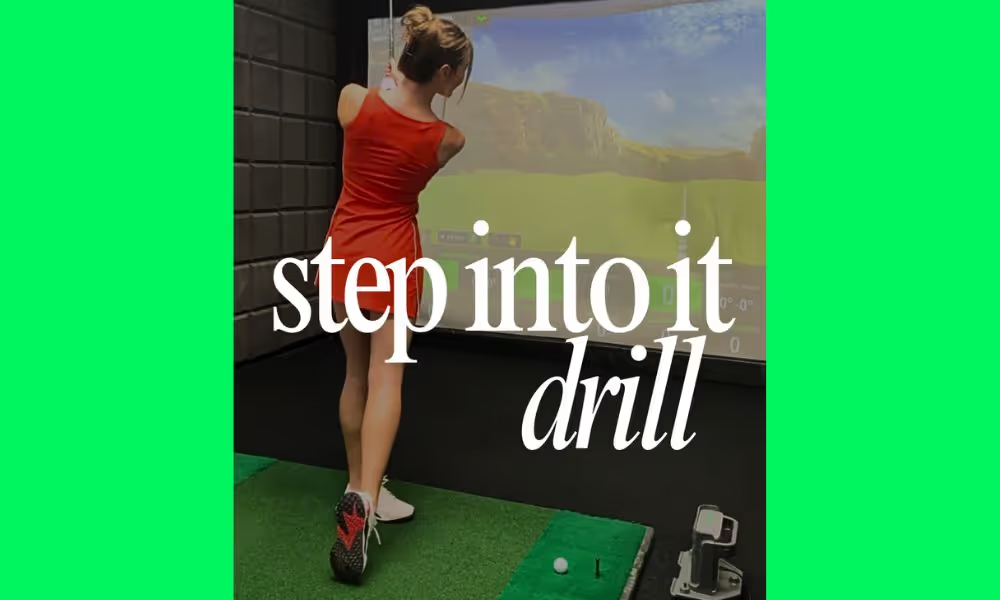
Mariah’s highlights one of the best parts of coaching: watching real progress unfold through simple, focused practice. With the “Step Into It” drill, she discovered how rhythm, sequencing, and balance can improve without overthinking mechanics.
Table of Contents:
Every golfer who has plateaued feels the frustration that comes from not knowing what to work on next. The answer depends entirely on who’s watching. A playing partner blames tempo. One video blames the grip, while a social media post says its the hips. GOLFTEC’s database of more than 14 million analyzed swings shows any one a half dozen technical issues can produce the same wild curve, lost distance or inconsistent contact. And the fix for one is frequently the opposite of the fix for another.
That’s the main limitation of any casual tip you might get from a playing partner or a social media post. It can be technically correct for some players, but not for you.
What OPTIMOTION Sees
GOLFTEC’s answer to that problem is set of high-speed cameras and enough processing power to turn what they capture into something a person can act on. The system, called OPTIMOTION, builds a markerless 3D model of a golfer’s swing, tracking 15 joint centers and pulling more than 4,000 data points from a single pass at the ball. No sensors taped to your hip, no suit, no delay while someone sets up markers on your body — the cameras do the work while you swing the way you’d swing anyway. Paired with launch monitor readings on ball speed, launch angle, spin rate, carry distance, clubhead speed and face angle at impact, the two systems together answer a question a friend’s tip can’t: what did your particular swing just do, and why did the ball react the way it did.
What Improvement Looks Like
To see GOLFTEC's game improvement process in action, check out the two diagnostic experiences show in the new Swing Autopsy series. In one episode, Mikah Johnson, a Teaching Quality Specialist on GOLFTEC’s coach-training staff at the company’s headquarters, works through a session with Beth, who came in working on distance and contact. Her numbers showed why both were capped: her hip sway and her shoulder sway were moving toward the target at almost the same rate through the downswing, which is not how it works for a tour player like Anne Van Dam, whose hips clear well ahead of her shoulders in the same phase of the swing. That missing separation, not a tempo issue or a lack of effort, was the actual limiter. Johnson built a specific drill around it, a pool noodle held at Beth’s lead ear to teach her hips to move toward the target while her head stayed back, and then measured whether it worked the same way the problem got found. Her smash factor went from 1.08 to 1.13. Her swing path went from eight or nine degrees out-to-in to inside the target line.
In another episode, Taj came in generating real speed but losing distance to inconsistent contact, and Johnson’s OPTIMOTION read pointed to something happening earlier in the swing than Taj expected: not enough backward bend, the spine tilt away from the target that creates room for a full, efficient backswing. Without it, Taj was working from a shorter, more restricted turn no matter how hard he swung through the ball. [Watch that session here.] Johnson built a drill to lengthen and clean up that backswing position, had Taj hit balls with the new feel, and checked the OPTIMOTION numbers again instead of asking how it felt. The readout showed more turn and more ball speed off the same effort. Different player, different fault, same method: find the actual cause, build a fix around it, measure whether the fix worked.
That’s a plan working, not a guess getting lucky.
The Difference Between a Feel and a Fact
One player’s numbers are a story. GOLFTEC has enough history now to check its own math across everyone. Ninety-six percent of GOLFTEC students who complete a plan show real improvement, and across nearly two million golfers coached, the average gain is more than seven strokes and more than 20 yards off the tee. Those are figures built from real rounds, not one good range session — and a good range session is exactly the trap a coach is trained to name. Three solid shots with a new feel can convince anyone the problem is solved. Two weeks later, when the feel fades, the old pattern comes back, because a feeling was never evidence in the first place. A shoulder turn that moves from 73 degrees to 88 degrees across six lessons, tracked and repeated, is evidence. So is a smash factor that holds at 1.13 across three sessions instead of showing up once and disappearing.
Limited Time Only — Play Better for Less
GOLFTEC's Summer Sale runs now through the end of August. It's the best time to save on an introductory Game Evaluation and on any lesson plan. Get a Game Evaluation for free with the purchase of any lesson plan (a $150 value), and save up to 25 percent on any plan. Your OPTIMOTION numbers, the coach, the plan are the same in September as they are now. You'll just pay more.
Bring the swing you have and see how much better you can get. Check out the sale today.

Play the best golf of your life. GOLFTEC Coaches use cutting-edge tech and proven methods to level up your game fast.
Book a Lesson
Play Better!
Book a Fitting
Play Better!