The banner is to inform visitors of an important message

.webp)
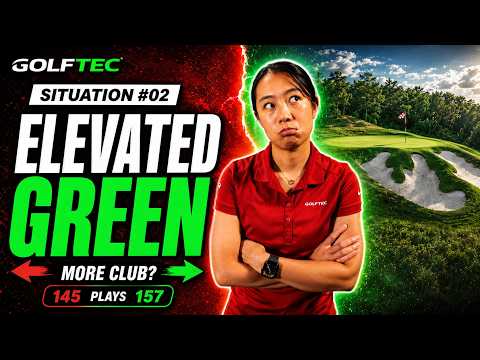
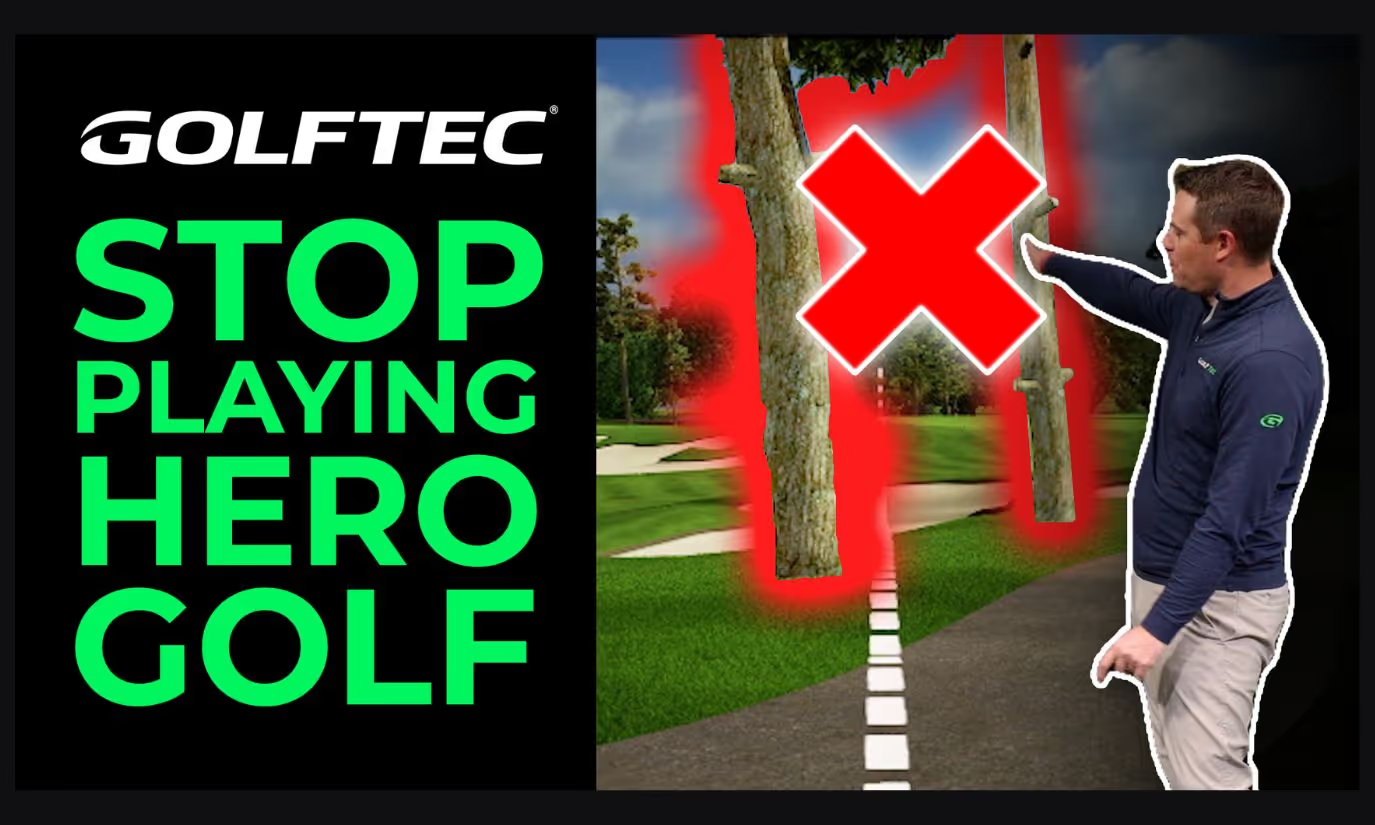
Knowing when to go for it and when to lay up is one of the fastest ways to lower your scores. In this on-course strategy lesson, we walk through real scenarios to show how smarter decisions off the tee and into greens can help you avoid penalty shots and big numbers.
00:00:00 - Payton is about to discuss different scenarios on when to take risks and when to lay low.
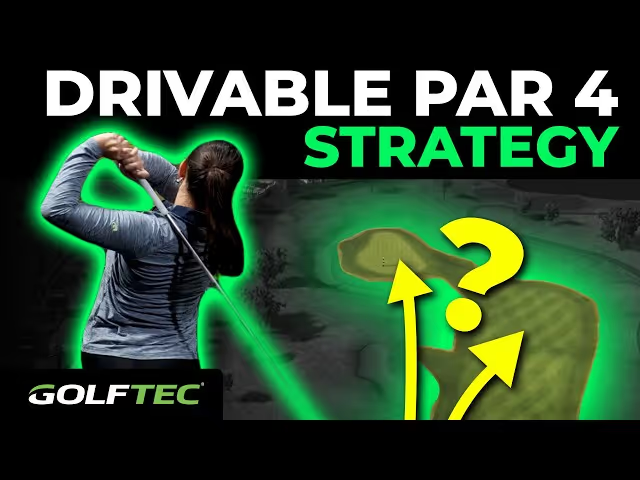
00:00:14 - On this par 4 T-box, you must decide whether to carry water that splits the fairway by hitting a driver about 225 yards or play it safer within the 184-yard landing zone.
00:01:04 - If you can't carry the distance needed to clear the water hazard, it's better to lay up with a shorter club to avoid trouble and score lower.
00:01:48 - The plan is to line you up along the left edge of the fairway, then take the shot and see where it lands.
00:02:04 - The key is to play it safe by laying up on dry land instead of risking the water, so you can have a better shot next.
00:02:26 - If you're not confident in clearing the water hazard, it's safer to lay up and avoid risk, even if you didn't hit your best drive.
00:03:07 - When facing a 170-yard shot with obstacles like trees and water, focus on carrying the ball at least 105 to 110 yards in the air, aiming straight for the shortest distance rather than necessarily reaching the green.
00:03:56 - The speaker advises aiming past the water with a sevenwood as a reasonable and achievable goal, emphasizing the importance of considering obstacles rather than just distance.
00:04:44 - Understanding golf strategy is key, as sometimes the shortest path isn't the best way to shoot a good score.
⛳ Choosing to lay up instead of going for it can help avoid risky hazards like water on a golf course.
⚠️ Always consider whether you can reliably carry your shot over trouble before using a powerful club.
🧩 Golf strategy is not only about the total distance but also about identifying hazards between you and your target.
📏 The shortest physical route may not always be the best option for scoring in golf—sometimes a safer path works better.
🎯 Thinking through each shot and club selection can make a big difference for golfers of all skill levels.
00:00:00 - So Payton, I've got some different scenarios I'm going to run you through. We're going to talk about when do you go for it and when do you lay out. >> Ready? >> Ready. >> Okay. [music]
00:00:14 - So, first scenario right here. We are on a T- box. This is a par4. Um you can kind of see up on the mini map on the right hand side. You've got water obviously right in front of you off the [music] tea, but the biggest thing here is the water that kind of cuts the fairway in half. >> Okay. So, I've set it up here. There's 184 yds basically to the end of the fairway. Okay. If you were going to go for it, you'd have to essentially carry that water and hit it closer to like
00:00:38 - that 225 mark. So, for you, this is we're we're playing golf. We're on this T- box. What would you do? >> Well, if I'm on T- box and I have my driver, I'd probably go for it. >> Okay. >> So, how far do you carry your driver? around the 200 205, but I think I could swing it pretty hard to carry it a little. >> So, this is this is perfect. This is what I hear from a lot of golfers. Okay, so I'm gonna have you do both. I'm gonna have you hit one with your driver and
00:01:03 - then we're going to have one where you lay up. Okay, the way that I would look at it is this. If there's trouble that you have to carry it over, so like in this case, your water your your ball is not going to land in the water and then bounce through it, like it's going to hit the water and stay in the water. Okay? So, if you can't carry that distance that you need to get over the water, which is right around that 210, 215, 220 mark, um, I wouldn't hit a driver. I would hit a club that leaves
00:01:25 - you short of that. Okay? That's going to give you the best chance to shoot the lowest scores. Now, [music] let's say you carried your driver 240 on average. I'd say totally reasonable to pull out driver and go for it on this one. But for you, this is kind of that tweener sort of not really sure which one to do. So, we're going to do both and let's see the results for each one. >> All right. Cool. So, first one, we're going to hit the layup shot. You've got your sevenwood. You tend to curve the
00:01:47 - ball a little bit to the right. So, I'm just going to have you lined up sort of down the left edge of the fairway. Um, go ahead, set up. [music] Hit this shot. Let's see where you end up.
00:02:04 - >> Totally fine. So, I know you didn't hit it great, but that's the beauty of what we're talking about. Like, if you're going to lay up, lay up. [music] Don't bring the water into play. I know that's not the best shot you could ever possibly hit, but it's on dry land. It's safe. You got an opportunity to hit your next shot over the water and then go from there. Now, let's hit your driver.
00:02:26 - Oh, no. So, there you go. So, there's the example I was talking about. So, you even on that drive, you didn't hit that as well as I know you can. Like, I know that was like a 175. [music] You typically get it closer to 200ish. Um, so that wasn't even the best drive you can hit, but that's where the problems come in, right? [music] You take that club that brings the trouble into play. Now you have to hit basically a perfect shot in order to not be in the water.
00:02:47 - So, um, in this scenario, unless you are 100% sure you can carry that water, I would always make sure you're laying up to a safe distance so you can give yourself a better chance to make a good score. >> All right. [music] >> Should we try the next one? >> Yeah, let's try the next one. >> Okay, Aiden, you're on a par five now. Okay. >> Okay. You hit a really, really good drive. All right. This could even be your T-OT. Let's just for argument sake say that it is. You crushed one. >> [music]
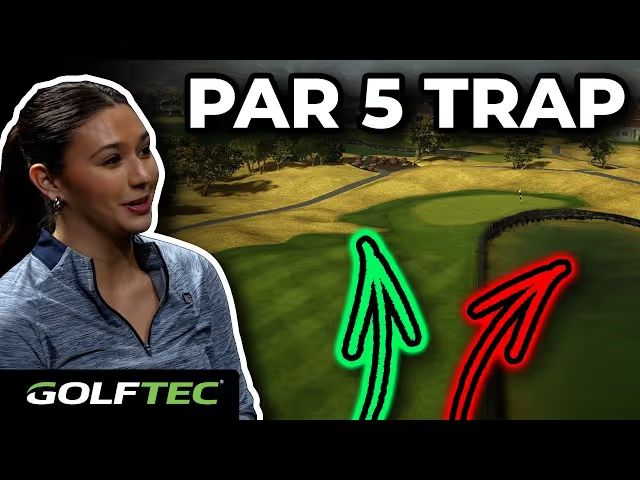
00:03:07 - >> got 170 yards basically to the flight. Okay, if we look at the fly over here, [music] you can see how you've got some trees in front of you. You've also got water down there and then you've got, you know, green and bunker and all that. So, [music] in this example, got 170 yards. >> What are you thinking? >> I'm still going to go for it. >> Okay. >> Cuz I just feel that [music] shortest distance to go straight. So, I'd rather just hit it straight. >> Totally fair. So, this would be the way
00:03:33 - that I would think about this for you at home if you're a high handicapper. Like if we go back to the traditional view here, what you really need to be thinking about is what is the minimum distance that I need to carry this golf ball. Okay? [music] So you've got 170 yards total. We're not necessarily worried about getting it all the way to the green, but we have to carry this ball. You can see on the mini map up on the right. This ball has to go at least probably 105 to 110 yards in the air to
00:03:56 - get over the water. Okay? [music] So in this example, I actually don't mind you feeling like, hey, I'm going to go for this because I think this is a totally reasonable and achievable goal for you. If you were maybe a little further back, let's say closer to the 200 yard range, that might not be the best option because again, bringing that water into play is like the worst thing you can do. So, you really need to think about this from the perspective of not just the
00:04:17 - distance you're trying to hit it, like the total distance, but like where's the trouble in between me and where the ball's going, >> right? So, for you, the trees aren't a problem. If you were a little further to the right, I'd say that you probably are hitting this ball and punching out to the left. Um, the water's aren't necessarily a problem. So, what are you hitting? Sevenwood. >> Sevenwood. >> Okay. So, grab your sevenwood. Let's see. You hit this one. That's smoked. [music] >> There we go.
00:04:41 - >> There it is. >> So, there you go. Like, I love that. That's like a perfect kind of strategy for you. You kind of see how we were thinking through that, though. >> Yeah. >> So, I think for you and for everybody at home, like whether you're a really good golfer or whether you're somebody that's just starting out, there's something to be said for like understanding some of the strategy, [music] right? It's not just about grabbing a club and hitting it at the flag and hoping that you get
00:05:02 - there. I love your mentality of like the shortest distance between two points is a straight line. Sometimes that's not always the best way to go when you're trying to shoot a score. So, really good job. Like I hope that was helpful for everybody and I hope that was helpful for you to learn a little bit about when to go for it, when not to.
Ready to elevate your game? Book a lesson or fitting at your nearest GOLFTEC location today!


Enter your info to have one of our expert coaches reach out about lessons, club fittings or practice!
.avif)
.avif)
.avif)
.avif)